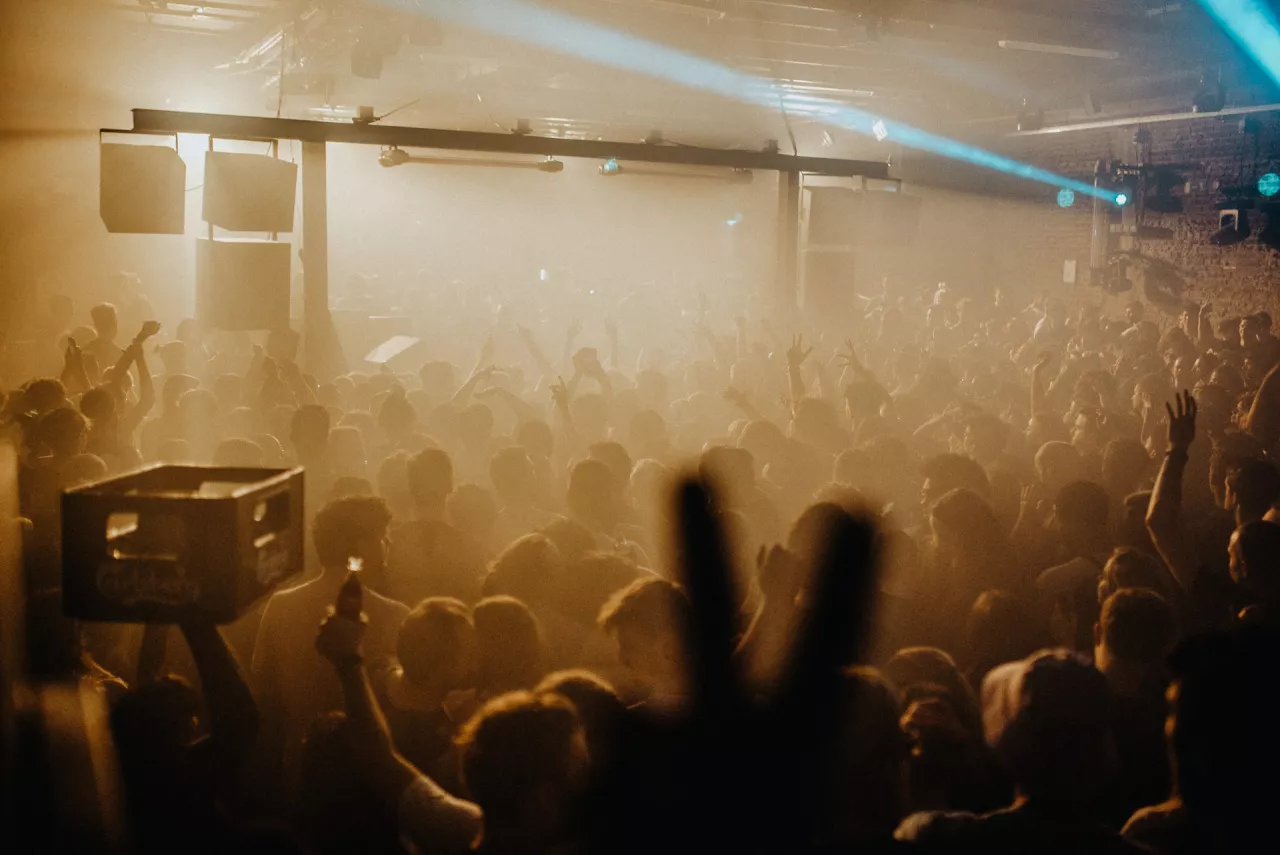
On a picturesque evening, hundreds of music lovers drift into the monumental Basilica of Koekelberg. For many, it’s their first time stepping inside. The sheer scale of the space is striking, as is the intimate atmosphere that settles in later that night when a gifted Belgian vocalist steals the show. Not far away, at the Laeken Planetarium, every head tilts skyward in unison as futuristic sounds from Detroit accompany the venue’s familiar celestial projections. Meanwhile, an air of anticipation fills Brussels North Station. Young people race through its corridors—not to catch a train, but to reach the grand hall, where their favourite DJs are pushing the sound to its limits. It’s just a snapshot—albeit an anachronistic one—of what unfolds each year during Listen Festival in Brussels.A decade ago, a Flemish-Walloon duo trio—as only Belgium could produce—gave birth to Listen Festival. Inspired by international trailblazers like Sónar in Barcelona and Dekmantel in Amsterdam, the festival set out to connect electronic music with urban culture by bringing the entire city onto the same wavelength for one weekend. Over the years, Listen Festival has pitched up in every corner of Brussels, collaborated with a long list of local collectives and cultural institutions, hosted more than 600 DJs and live acts, and welcomed 20,000 visitors during its most recent edition. Looking at today’s packed festival calendar, it’s hard to imagine, but back in 2016 Brussels had no city festival dedicated to alternative electronic music. It may only be ten years ago, yet the first edition of Listen Festival belonged to a very different moment in time. To put it mildly, a lot has changed since then. Time to look back.


The Early Days
“‘I remember those first conversations rather differently,’ laughs Lorenzo Serra. Dirk De Ruyck nods, smiling. By 2016, the two cultural entrepreneurs were already seasoned figures in Belgium’s nightlife scene.”
Lorenzo Serra is a seasoned Brussels entrepreneur deeply rooted in the nightlife scene. As a teenager and in his twenties, he discovered the nightlife at Brussels' Mirano, Le Garage, La Haute Tension and many other venues, organising raves with friends in a youth centre and even once at El Disco Rojo, the predecessor of Fuse. In 2003, driven by his passion for electro house, he co-launched Dirty Dancing at Mirano, which, between 2009 and the mid-2010s, evolved into Libertine Supersport, first at K-Nal and later at various venues across the city. Both concepts quickly became the talk of the town, with Serra mainly taking care of the production and political side of things. When it came to the artistic direction, he consistently surrounded himself with some of the strongest voices in the field. Listen Festival was no exception. The idea first took shape during a conversation with Dirk De Ruyck—a Ghent native who had made the move to the outskirts of Brussels—on a café terrace in the Belgian capital.


“I barely knew Brussels back then,” De Ruyck admits today. The creative polymath and committed aesthete—a self-confessed devotee of Peter Saville, the iconic graphic designer behind Manchester’s Factory Records—had already built an impressive career in nightlife and the music industry. In Ghent, he helped launch the influential Eskimo and Belmondo parties, co-founded the legendary Culture Club and later Make Up Club, and ran the Eskimo record label. The biggest lesson he took from those years? That dance music is a vast universe, one that resists easy categorisation. Just look at renowned Ghent DJs like 2manydjs or The Glimmers—they both learned their craft in the East Flemish city.
“‘That kind of eclecticism—in Ghent, we’d programme hip-hop, drum & bass and house in neighbouring rooms—simply didn’t exist in Brussels,’ De Ruyck recalls. ‘That’s exactly what we wanted Listen Festival to be: a diverse snapshot of everything the Brussels and international electronic music scenes have to offer.’”


The third founder is Serge Vanderheyden, a Brussels-based event organiser and one of the driving forces behind the exceptional Who's Who’s Land club during the late 1990s. He was the quiet but essential link in the chain that led to the creation and growth of Listen Festival. And he came up with the name!
By the mid-2010s, Brussels’ nightlife wasn’t exactly booming. There was Fuse—there was always Fuse—but beyond that, the city’s after-dark scene felt relatively subdued. Things were happening, but you had to know where to look. The seeds of the revolution that would follow a few years later were quietly being planted deep underground. Young promoters were throwing their first parties, including the crews behind Deep In House (later C12), Crevette Records, Play Label and Kiosk Radio. There were, of course, a handful of established names too, such as Catclub, High Needs Low, La Démence and Technoon. Still, most people in Brussels looked to Amsterdam, Berlin and other Western European capitals for inspiration.
It was in that period of relative calm that Lorenzo Serra and Dirk De Ruyck came up with the idea for a new city festival. It was first called BXL BY DAY / BXL BY NIGHT, then briefly SOON, before eventually becoming the name that has adorned posters across the city for the past decade: Listen Festival. At its most literal, the name could be read as a simple call to action—listen to us. But from the outset, it also reflected a broader ambition: to elevate nightlife as an essential part of the city’s cultural fabric. Serra still remembers one particular moment vividly. “I’ll never forget hearing someone say, in a Brussels government office, ‘We don’t support parties. We support culture, and parties aren’t culture.’ That’s when I realised we still had a long road ahead of us.” De Ruyck picks up the thread: “That was already our tagline at Culture Club back in 2000: Nightlife is culture, culture is nightlife.”


Adding Depth
To add depth to its nighttime programme, the festival’s inaugural edition in 2016 featured a record fair, a conference with talks, debates and workshops, and an installation by renowned Austrian artist Peter Kogler. A year later, it expanded the programme with a live broadcast and a gear fair, followed the year after by an exhibition on record collectors and an installation by Radio Soulwax.
From day one, the festival’s nighttime programme revolved around a central club night, complemented by concerts and parties spread across the city. To make that happen, Listen partnered with local collectives and promoters throughout the festival weekend—an approach inspired by the influential Amsterdam Dance Event. The strength of that model lies in its ability to shine a light on the existing scene. Looking back, the list of collaborators from the past decade reads like an archive of Brussels nightlife: Not Your Techno, Slagwerk, He4rtbroken, Mo Mamba, Under My Garage, Chanoirs, Gay Haze, Magma, Local Slang, Breaxx, and many more. And that, perhaps, is the biggest change of the past ten years. Culture has always been shaped by successive generations, but in club culture that turnover happens at remarkable speed. As a result, today’s festival programme features barely any of the names that helped define its earliest editions.
A second observation is one that invites a degree of embarrassment. In 2016, no less than 94.1% of Listen Festival’s lineup was made up of men. By 2025, that figure had fallen to 47.5%. Today, the festival actively strives for gender balance. Back in 2016, however, the issue was barely part of the conversation. While we still live in a society shaped by structural gender inequality—with persistent pay gaps and women continuing to shoulder a disproportionate share of unpaid care work—the imbalance on festival lineups has at least begun to be addressed. Listen’s shift towards greater gender equality happened gradually over the past decade. It was therefore fair that, when the festival launched its “Celebrating Music & Diversity” slogan in 2020, it was met with criticism. Rather than dismissing those voices, the criticism became a catalyst for reflection, accountability and meaningful change.


In 2022, Listen launched Our Scene, an umbrella platform for the festival’s efforts to reflect on—and contribute to—the scene of which it is a part. Its first expression was a magazine, distributed free throughout the festival weekend and packed with interviews featuring DJs, promoters, collectives, musicians, scenographers and other key voices from the community. In 2023 and 2024, Our Scene also evolved into a multi-day programme at Beursschouwburg, where debates, talks and screenings explored topics including urban development, inclusion, sustainability, heritage, education and community building. Discussions with titles such as Navigating Politics as a Queer Promoter and Activism in Dance: Using Dance Music to Bring Change remain fresh in the minds of the hundreds who attended.


Historical Context
For veterans like Lorenzo Serra and Dirk De Ruyck—who took their first steps as clubbers in the late 1980s, when house and techno were still in their infancy—the evolution of the past decade can largely be summed up in one word: scale. When Listen Festival launched in 2016, it stood more or less alone as Brussels’ dedicated city festival for electronic music. At the time, Horst Arts & Music had only just held its first two editions at the Castle of Horst in Flemish Brabant. Today, the landscape has expanded exponentially. The result is not only a far busier cultural calendar, but also a potential audience many times larger than it was a decade ago.
Viewed through a historical lens, the past four decades tell the story of a subculture that has grown from the margins into a mainstream cultural force. In Belgium during the 1990s, anyone interested in electronic dance music belonged to a relatively small scene, gathering in clubs such as Fuse, Boccaccio Life, La Rocca, Cherry Moon, Who’s Who’s Land and Café d’Anvers. The first raves—from sports halls to temporary party tents—were attended by largely the same community. When I Love Techno set a new benchmark in Ghent’s Vooruit in 1995, before moving to Flanders Expo two years later, the scene truly began to gather momentum. Electronic dance music found its way onto radio playlists and into the mainstream press. Since 2005, Tomorrowland has taken that evolution even further. Every year, hundreds of thousands of people descend on a park in the Antwerp municipality of Boom for one of the world’s largest electronic music festivals. Along the way, the festival landscape itself has transformed—driven in part by Tomorrowland’s success—into a major entertainment industry where music is only one part of the offering. Today’s festivals compete through immersive experiences, elaborate scenography, fantastical stage design and a host of carefully crafted details beyond the music itself.


Belgium has long been one of Europe’s great festival nations, home to institutions such as Rock Werchter, Pukkelpop and Dour Festival, alongside hundreds of mid-sized and independent events. Yet in 2016, Brussels still lacked a city festival dedicated to electronic music that could truly claim the title. Until 2011, Groove City had occupied that space at Brussels Kart Expo, before quietly disappearing from the calendar. Festivals such as Les Nuits Botanique and Couleur Café have, of course, always programmed electronic artists, but neither can reasonably be described as an electronic music festival. In other words, there was a clear gap waiting to be filled.
Listen co-founder Dirk De Ruyck vividly remembers those early years. “People were talking about us. We had carved out a distinctive place on the European festival map. Today, every country or capital seems to have five festivals like Listen—and they’re all operating at an incredibly high level. It’s remarkable.” Brussels, too, has witnessed an explosion of ambitious festivals. Horst Arts & Music has since moved to Vilvoorde but is generally considered part of the wider Brussels scene. Fuse now stages its annual XRDS festival beneath a motorway bridge in Anderlecht, Kiosk Radio hosts Woodblocks, Reset launched (and perhaps retired) Abrupt, while Circle Park brings an open-air festival atmosphere to the city throughout the summer. And there are many more.
Uncharted Spaces and New Challenges
For its first edition, Listen Festival found a home in an unusual venue—at least by clubbing standards. Beneath Mont des Arts, the landmark hill connecting Brussels’ upper and lower town, the festival took over SQUARE, the vast convention centre whose glass entrance pavilion is all that rises above ground. Hidden below the surface, a network of halls opened up to festivalgoers, who eagerly discovered not only the DJs and live acts, but also the venue’s unexpected subterranean spaces. The inaugural edition was a success, leaving both audiences and organisers eager for more.
Listen Festival returned to SQUARE for its second edition in 2017, once again taking over the convention centre for an entire weekend. But the following year brought an unexpected setback. An engineering assessment revealed that the floor of the venue’s largest hall—where the third edition was due to take place—could not safely withstand the dynamic load of a dancing crowd. It was a major blow, forcing the organisers back to square one.


Even so, SQUARE had already helped shape the festival’s identity. Listen Festival set out not only to connect different corners of Brussels, but also to activate striking locations not usually associated with nightlife. Over the past decade, that vision has led the festival to venues including Brussels North, Central and Congrès railway stations, the former printing works of the National Bank of Belgium, and—perhaps most memorably—the tunnels beneath Avenue Louise and Place Stéphanie. More on those later.
Over the past decade, Listen has also forged partnerships with many of Brussels’ leading cultural venues and institutions, including AB, Botanique, Flagey, VK, Reset, Volta, Beursschouwburg, ING Art Center, Halles de Schaerbeek, Les Brigittines, Bozar, Pilar and La Madeleine. The festival has worked closely with clubs such as C12, Fuse, La Cabane, UMI, Jalousy and Bonnefooi, extending its reach as far as Buda in the north of the city, on the border with Vilvoorde. Listen has even brought music into the National Basilica of Koekelberg and the Church of Our Lady of Laeken—two remarkable religious landmarks that generously opened their doors to the festival.


A New Generation
History is ultimately shaped by the people who make it. Around 2016, a new generation was coming of age in Brussels. They belonged to the tail end of Generation Y—the millennials—and were in their early twenties, having already gained their first experience as cultural entrepreneurs. They were ready to build something of their own. New initiatives began appearing across the city. In September 2016, a storefront in the working-class Marolles neighbourhood was transformed into the record shop Crevette Records. In the spring of 2017, four friends launched Kiosk Radio from a small wooden pavilion beneath the trees of Brussels Park. Early in 2018, nightclub C12 opened its doors in the vacant Horta Gallery, right in the heart of the city, accessed via a side entrance of Brussels Central Station. Today, all three have become essential institutions within Brussels’ electronic music scene.
As new players entered the scene, they brought greater momentum, stronger competition and, ultimately, a healthier ecosystem. Listen Festival recognised their strengths and gradually stepped away from activities that others were better placed to lead. The live broadcast had become redundant, while the record fair quietly disappeared from the programme. Following the setback at SQUARE, Listen relocated its nighttime programme to C12 in 2018. Across the Horta Gallery’s central hall and the club’s two rooms, artists including Actress, Mount Kimbie, Elena Colombi, Stellar OM Source, AliA and Bicep took to the stage. The festival returned to C12 again in 2019.


COVID-19
A fresh energy had begun to sweep through Brussels by the end of the 2010s. That made the events of early 2020 all the more devastating. As the world ground to a halt under the impact of COVID-19, Listen Festival was forced to scrap an entire edition that had already been fully planned. It was a moment of upheaval. Across festival calendars and club listings alike, one word kept appearing: postponed. Soon after, it was replaced by another: cancelled.
The pandemic ushered in two years of uncertainty—a cycle of cautious optimism, renewed disappointment and endless postponements, each announcement feeling like another turn through the same claustrophobic time loop. It wasn’t until the spring of 2022 that Listen Festival could finally return. The world exhaled. Dancefloors filled once again with an intensity that perfectly captured the Dutch word knaldrang: the almost irrepressible urge to go out, celebrate and make up for lost time.


Was there no silver lining to the pandemic? There was. The crisis made it painfully clear that nightlife and the festival sector needed stronger structures for collaboration in the face of large-scale disruptions. Until then, however, no such framework really existed. That realisation prompted Lorenzo Serra to take action. He helped establish Brussels By Night, a non-profit organisation dedicated to building a healthier, more resilient ecosystem for nightlife across the Brussels-Capital Region.
Crises rarely come alone. In 2021, the #BalanceTonBar movement exposed deep-rooted issues around the safety of women in nightlife, triggering a wave of justified outrage across social media. For the sector, there was little choice but to confront its own shortcomings. Once again, Brussels By Night took the lead. Since 2022, the organisation has been building expertise and training nightlife professionals in harm reduction practices, helping venues create safer and more inclusive environments.
Listen Festival also took a critical look at its own practices. In 2019 it launched the United Against Harassment campaign – reinforced In 2025 together with the Belgian National Lottery – reaffirming its commitment to safer nightlife. Through a combination of preventive and responsive measures—including a dedicated care team and clearly designated care spaces—the festival set out to create an environment where everyone could feel safe, respected and welcome.


Clubbing as Intangible Cultural Heritage
In 2023, Brussels By Night, the Brussels Night Council and several other partners succeeded in having clubbing officially recognised as intangible cultural heritage. The designation marked a profound shift in perspective. Nightlife was no longer viewed solely through the lens of regulation or public safety, but recognised as a living cultural practice—one shaped by skills, professions, communities, rituals and creative ecosystems that have been part of Brussels’ identity for decades.
The desire to firmly establish the cultural value of nightlife was one of the driving forces behind Listen Festival from the very beginning. Founder Lorenzo Serra remembers feeling that ambition reflected back at him in 2017, while preparing the festival’s second edition. Sitting in an office inside Flagey—the magnificent 1930s Art Deco landmark in Ixelles—the venue’s programmer told him they were eager to collaborate with Listen. Serra still remembers the words vividly: “We are the ‘old’ way of culture; you are the new generation.” It was a moment, he says, that filled him with pride.


Another New Generation
Every few years, a new generation arrives at the gates of a community or subculture—sometimes patiently, more often by kicking the door wide open. Creation inevitably breeds renewal, while the underground continually challenges the establishment. What begins on the fringes eventually reaches the mainstream, prompting the underground to move on in search of new forms. Trends and styles rarely disappear; they move in cycles. Sounds that filled dancefloors three decades ago find new audiences, while emerging artists reshape them through contemporary technologies. It is a process that seems impossible to stop.
Or is it? During the enforced pause brought about by the COVID-19 pandemic, public life in Western Europe came to an abrupt standstill for the first prolonged period since the Second World War. Only years later, Dirk De Ruyck argues, did the true impact of that interruption become apparent. “A lot happened during those two years—we just didn’t see it because nobody was going out. But within youth culture, within the new generation, things were already taking shape. Then life resumed and suddenly hard house was back, and everyone was asking, ‘Where did this come from?’ The truth is, it had been there all along. We just didn’t witness it happening.” Lorenzo Serra adds: “So many artists were on the verge of their breakthrough. They were right in the middle of that momentum when everything was suddenly placed under a glass dome. There was an enormous amount of pent-up energy waiting to be released.”


Disruptive Times
On 22 March 2016, Brussels was shaken by a series of terrorist attacks at Zaventem Airport and the city’s metro network. Less than a month later, the inaugural edition of Listen Festival took place.
The Brussels attacks, the COVID-19 pandemic—these are the kinds of defining events whose consequences ripple through society as a whole. The same can be said of today’s wars and growing geopolitical tensions. The past decade has been marked by successive crises, making it increasingly difficult to navigate an ever more uncertain world. And that is before considering the accelerating climate crisis. Together, these upheavals have fuelled an unprecedented wave of inflation, from which culture, nightlife and the wider live music sector have not been spared. The cost of living—and with it, the cost of making and experiencing culture—has risen at a dizzying pace.


What happens in the world inevitably shapes the music we listen to. Anyone expecting a euphoric catharsis after the pandemic lockdowns was in for a surprise. Tempos accelerated, dancefloors embraced techier, proggier and harder sounds, and musical identities became increasingly difficult to pin down. As Resident Advisor observed in a recent mini-documentary on the sound of the 2020s, the age of monoculture is over. Where previous decades could often be defined by a few dominant aesthetics, today’s musical landscape resists easy categorisation. With several years of the decade still ahead, even Resident Advisor concluded that the 2020s have yet to produce a single defining sound. The reasons are manifold and extend beyond the scope of this story, but it is clear that economic pressure—and the way inflation affects creativity, risk-taking and artistic development—has played a part.
Then there is the relentless acceleration of digitalisation. Since the rise of the internet in the late 1990s, technological change has only gathered pace, most recently with the rapid emergence of AI. These are deeply disruptive times, marked by uncertainty, fragmentation and growing polarisation.


Newspaper Headlines
If the headlines are to be believed, nightlife is living on borrowed time. “Gen Zzz? Nightlife isn’t dead—it’s at the pub,” declared the Belgian newspaper De Standaard in February 2026. A few months later, the Dutch daily Trouw asked: “Will nightclubs survive Gen Z, a generation that’s dancing less?” Similar narratives have emerged across Western Europe, fuelling speculation about the future of club culture.
Yet the picture on the ground is more nuanced. Veteran DJ Lefto continues to see new clubs opening around the world and still regularly plays to packed dancefloors. At the same time, he acknowledges the economic reality facing younger generations. “It’s more a problem of tight budgets for the youth due to inflation in society,” he says. Seb Desprez—better known as DJ Bon Public and co-founder of the Magma collective—shares that view. “Going out to clubs is more expensive than ever. I don’t think young people have lost interest in the music—they simply can’t afford to go out every weekend.”


Still, the question is whether the equation is really that straightforward: inflation equals higher ticket prices, which means Gen Z stops going out. There is little doubt that the cost of living has risen dramatically. But perhaps something else is happening, too. After nearly four decades of evolution, electronic music and nightlife may simply have become too hybrid, too diverse and too sprawling to be understood as a single dominant culture—much like Resident Advisor argues in its recent mini-documentary on the sound of the 2020s. Former Listen team member and Kiosk Radio co-founder Nicolas Bucci puts it this way: “Younger generations have been exposed to much more than we did. Their interests are broader, their identities are more layered, and it’s becoming harder to reduce people to specific subcultures with defined features. Even some of the assumptions that historically seemed inseparable from nightlife, like the relationship between clubbing and alcohol or drugs, can no longer be taken for granted. From what I see, people are still looking for connection and collective experiences. They’re just finding them in different ways. A radio show, an exhibition, a sound healing session or a club night can all be part of the same cultural experience. Rather than disappearing, I feel nightlife is simply evolving into something more complex.”
Zoé Devaux—better known as DJ Zouzibabe and through her work as a programmer for Paradise City and Fifty Lab—has recently noticed an interesting shift. “I’ve seen younger people on TikTok claiming they were on their way to our festival on their own, reaching out to others, saying they go to festivals specifically to find connection with other people,” she explains. For Devaux, who was herself born in the mid-1990s and belongs to the younger end of the millennial generation, that is not something she readily associates with her own peers. Does this suggest that Gen Z is beginning to feel confident about going out again, following the #BalanceTonBar movement and the wider conversation around safety on the dancefloor? “I wouldn’t generalise,” she says. “But if festivals have genuinely done the work, and their safety policies are more than just lip service, then I think young people are still very eager to go out.”


Tunnels and Open-airs
The most striking event in Listen Festival’s first decade was undoubtedly The Tunnels. Beneath the busy Avenue Louise and Place Stéphanie, where an extensive network of road tunnels normally serves as one of Brussels’ key traffic arteries, the festival transformed the underground infrastructure into a temporary rave venue, complete with a stage, bars and everything else needed to host thousands of people. The inaugural edition in 2025 was an immediate success, and tickets for the 2026 follow-up—organised in collaboration with Hangar—sold out in no time.
The idea came to Lorenzo Serra and and Serge Vanderheyden while driving through the tunnels, searching for a suitable location in Brussels capable of hosting a large-scale rave. The answer, quite literally, was right in front of him. What is perhaps even more remarkable is that the city authorities didn’t laugh the idea out of the room, but instead embraced the vision and helped make it a reality.


The project says a great deal about the way the City of Brussels now approaches festivals and nightlife. Increasingly, it has embraced the idea of a vibrant city where culture, entertainment and nightlife are part of urban life around the clock. Especially in the wake of the pandemic—but not exclusively so—the city recognised the role that music events can play in boosting public morale and strengthening social life. Festivals also contribute to the city’s image, helping to attract visitors and reinforce Brussels’ cultural identity. Sometimes, a photograph of thousands of people dancing in an iconic location communicates more than a thousand words ever could.
In the aftermath of the COVID-19 pandemic, Brussels By Night was also tasked with helping to coordinate the city’s growing number of summer open-air events—single-day gatherings where DJs perform in public squares and other urban spaces. The result is the annual Brussels Open Air Festival, held at the end of each summer. These events have become recurring moments when the city actively opens itself up to electronic music culture. By working closely with Brussels By Night, the aim is to ensure that such events remain both safe and well-managed, balancing their impact on the city with the needs of residents, audiences and organisers alike.
Ever since the rise of electronic music and club culture in the early 1990s, there has been an inherent tension between day and night. Between those who value peace and quiet, and those who come alive after dark. Amplified electronic music—and the forms of hedonism that can accompany it—inevitably has an impact on the surrounding city. Open-air events and festivals take DJs and dancefloors out of clubs and into public space. A tunnel rave can disrupt traffic, while an outdoor party may require the temporary closure of a square or park. The challenge, then, lies in finding the right balance through dialogue and cooperation. The experience accumulated by organisations such as Listen Festival helps ensure that decisions are made in ways that benefit organisers, audiences, local residents and the city alike.


Another Ten Years
In 2026, Listen Festival reaches an important turning point. For the first time, the festival offers a single pass, granting access to every event from Friday night through to Sunday, covering more than 24 hours of club programming. With this new format, Listen aims to reinforce the identity it has built over the past decade—one rooted in exploration, discovery and a deep engagement with electronic music culture. In an increasingly hyperconnected, fast-moving and digitally driven world, the festival is choosing to place that experience firmly at its centre.
Last but not least, current artistic director Lucas Vandervelde shares his thoughts on the festival’s future: “It feels quite special to look back on these 10 years of Listen Festival in a year where we’re also changing up the format of the festival. With Listen the focus has always been on showcasing local talent and the uniqueness of our music scene. With our new format we extend upon this promise with one ticket that gives access to all of our venues, allowing the public to discover even more of Brussel’s blooming nightlife in 24 +++ hours.
We can’t wait to share what we have been preparing for Listen Festival 2026 and this year's programme features some absolute personal highlights for me. We're once again connecting the dots between exploring musical styles, nightlife culture and some of Brussel’s most iconic locations. I’ve had so many encounters with foreign artists and visitors during the festival who are always surprised how we manage to throw parties in these unique locations in Brussels. Integrating these locations with mainstays like Fuse, C12 and UMI is where the Listen concept really gels for us and this year there will be even more to discover.”
To another ten years. Happy birthday, Listen Festival!
Koen Galle
DJ, author (known for the book ‘Fuse: 30yrs of making noise’) and founder of AfterClub Publishing.